There are designers who follow culture, and then there are designers who quietly reshape it. Yoon Ahn and Verbal belong firmly in the latter camp. The Tokyo-based couple behind Ambush have spent the better part of two decades operating at an intersection that few others have managed to navigate with such effortless conviction — where hip-hop's restless energy meets the rigour of high fashion. The result is a brand that never quite fits any single category. And is all the more powerful for it.
Yoon Ahn was born in Seoul in 1977, the eldest child of a U.S. Army family perpetually in motion. Hawaii, California, back to Korea, and eventually the Seattle suburbs — her childhood was a series of uprooting and resettling, the kind of itinerant upbringing that either closes a person off to the world or cracks them permanently open to it. Yoon grew up obsessed with Eddie Vedder and the grunge scene, devoured the pages of i-D, Vogue, and The Face, dreamt of New York and London. Finally, she moved to Boston to study graphic design.
Verbal — Ryu Young-ki — was born a third-generation Korean in Tokyo, where his family ran a Pachinko business. He discovered hip-hop at a YMCA summer camp, briefly moved to England for his education, and eventually landed in Boston studying ministry before switching to Philosophy and Marketing. It was there, in the late 1990s, that the two met at church. Two displaced Koreans finding each other far from home. The beginning of something big.
Manche Designer folgen dem Zeitgeist – andere formen ihn. Yoon Ahn und Verbal gehören zur zweiten Sorte. Seit fast zwei Jahrzehnten bewegt sich das Duo hinter Ambush an einer Schnittstelle, die nur wenige mit derartiger Überzeugung bespielen: irgendwo zwischen Hip-Hop und Haute Couture, irgendwo zwischen japanischer Street-Kultur und Kunsthandwerksateliers der globalen Luxushäuser. Eine Marke, die in keine Schublade passt. Und die genau das zu ihrer Stärke gemacht hat.
Yoon Ahn wurde 1977 als ältestes Kind einer Militärfamilie in Seoul geboren. Lange bleiben würde sie nicht. Hawaii, Kalifornien, zurück nach Korea, die Vororte von Seattle – ihre Kindheit war eine ständige Abfolge von Abschiednehmen und Neuankommen. Die Art von Kindheit, die einen entweder verschliesst oder für immer auf der Suche hält. Bei Yoon war es Letzteres. Sie wuchs auf mit Eddie Vedder und Grunge, verschlang die Seiten von i-D, von Vogue und The Face, sie träumte von New York, träumte von London. Und zog schliesslich für ihr Grafikdesign-Studium nach Boston.
Verbal – Ryu Young-ki –, Koreaner in dritter Generation, wuchs in Tokio auf, wo seine Familie ein Pachinko-Unternehmen betrieb. Er erlag dem Hip-Hop in einem YMCA-Sommercamp, studierte kurzzeitig in England und wechselte dann nach Boston — zunächst für ein Theologiestudium, dann doch lieber für eine Ausbildung in Philosophie und Marketing. Und dort, im Boston der späten 1990er-Jahre, begegneten Verbal und Yoon in einer Kirche: zwei Koreaner, weit weg von zuhause. Der Anfang von etwas Grossem.
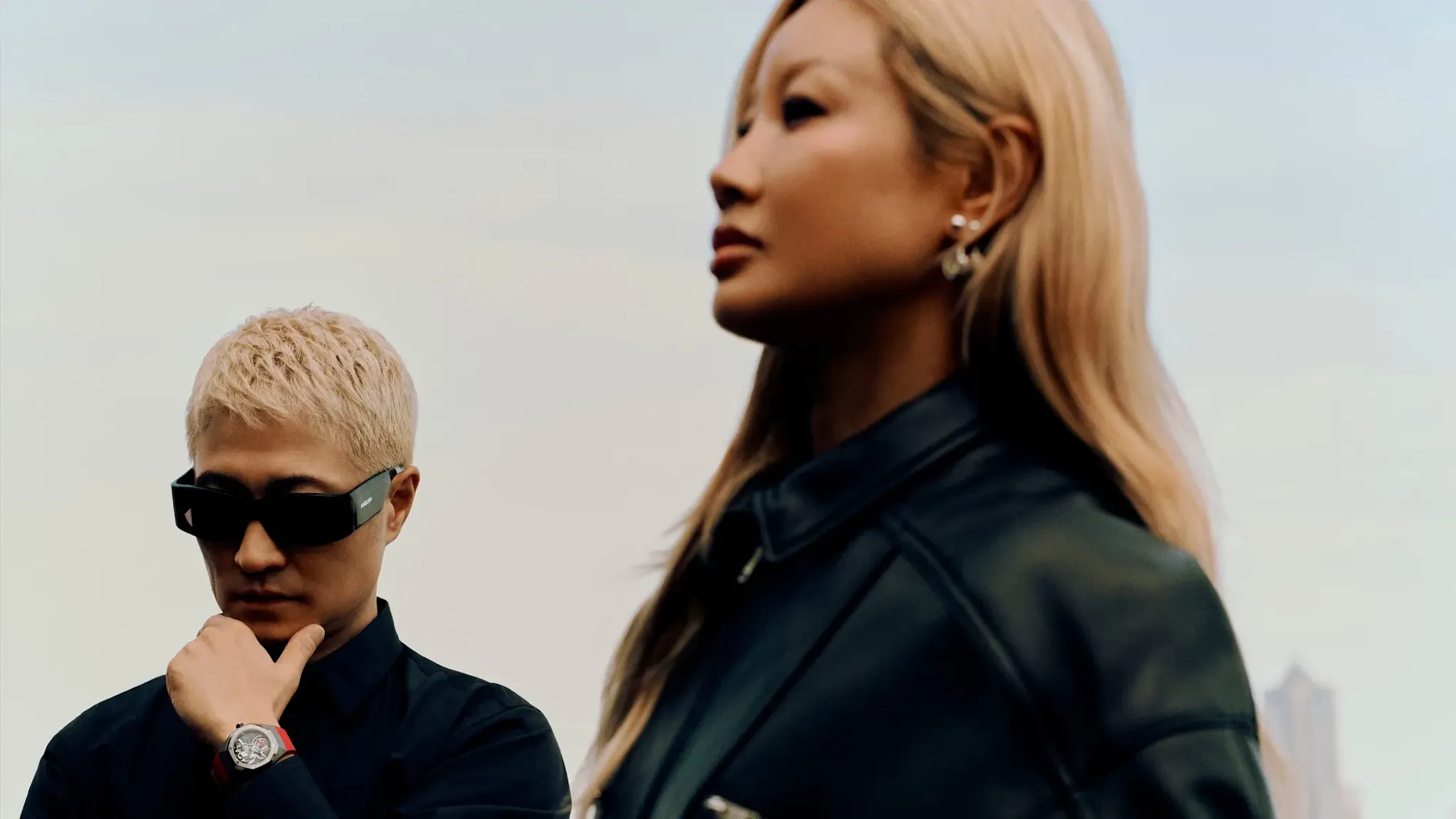
The duo created Ambush Design Company in 2002 as a design outlet for Yoon, under which she designed album artwork for a number of artists. In 2004, they founded a couture jewellery line called Antonio Murphy & Astro, and in 2008 established their second line, Ambush — born not from a business plan but from a simple desire to dress differently, to create pieces that felt like them rather than like anyone else. It was an instant success. And what began as an experimental jewellery line, over time, grew into a full unisex ready-to-wear label with a fiercely loyal global following. One that never believed the polite fiction the fashion industry was serving. One that made it its mission to rewrite its narrative.
What Yoon and Verbal understood early, long before it became the dominant logic of the industry, was that the walls between streetwear and luxury were always more porous than either side liked to admit. Ambush didn't tear them down; it simply moved through them with a fluency that few others had at the time. It was Yoon who first pushed Verbal to swap the oversized silhouettes of early 2000s rap for Raf Simons and Dior Homme — a small, personal act of style that pointed toward something much larger: the idea that hip-hop's relationship with luxury didn't have to be aspirational or performative, but could be critical, informed, and authorial.
That the world's biggest names kept finding their way to Ambush’s Tokyo studio said as much. In the years that followed, the duo collaborated across sportswear giants and Parisian fashion houses, Japanese avant-garde and global lifestyle brands, each one a choice driven by creative conviction, not commercial convenience. Yoon & Verbal for Louis Vuitton, Yoon & Verbal for Gentle Monster, Yoon & Verbal for Rimowa — Yoon & Verbal for Audemars Piguet.
2002 gründeten die beiden ihre erste gemeinsame Firma – zunächst als kreativen Kanal für Yoon, die dort unter anderem Album-Artworks für Musikerinnen und Musiker gestaltete. 2004 lancierten sie eine Couture-Schmucklinie namens Antonio Murphy & Astro, und 2008, aus dem schlichten Wunsch, sich anders zu kleiden, Stücke zu schaffen, die sich nach ihnen selbst anfühlen, Ambush. Der Erfolg liess nicht lange auf sich warten, und was als experimentelle Schmucklinie begann, wurde zu einem unisex Ready-to-wear-Label mit einer treuen Anhängerschaft rund um den Globus. Einer Marke, die sich nie so richtig an die Spielregeln der Modeindustrie halten wollte. Und genau damit dazu beigetragen hat, sie neu zu schreiben.
Was Yoon und Verbal früh erkannten, war, dass die Grenze zwischen Streetwear und Luxus schon immer durchlässiger war, als beide Seiten zugeben wollten. Ambush bewegte sich von Anfang an in beiden Welten – nicht als Statement, sondern weil es für die beiden schlicht selbstverständlich war. Es war Yoon, die Verbal dazu riet, die für die damalige Zeit typischen oversized Rap-Silhouetten gegen Looks von Raf Simons oder Dior Homme einzutauschen. Eine persönliche Stilentscheidung, die zu etwas viel Grösserem wurde: dem Beweis, dass Hip-Hop und Luxusmode auf Augenhöhe funktionieren können.
Dass im Verlauf der Jahre die grössten Namen der Branche, einer nach dem anderen, den Weg in Ambushs Tokioter Studio fanden, sprach für sich. Das Duo kollaborierte mit Sportswear-Giganten und Pariser Modehäusern, japanischen Avantgarde-Labels und globalen Lifestyle-Marken, jede Zusammenarbeit eine aus kreativer Überzeugung, nicht aus kommerziellem Kalkül. Yoon & Verbal für Louis Vuitton, Yoon & Verbal für Gentle Monster, Yoon & Verbal für Rimowa – Yoon & Verbal für Audemars Piguet.



Believing in the power of creativity to feed culture, connect people and broaden horizons, Audemars Piguet has long looked to the larger world for inspiration. In the beginning, the relationships were transactional in the most glamorous sense — limited editions tied to celebrities, to films, to cultural moments. Powerful as brand-building, but closer to endorsement than authorship. What shifted over time was AP's growing appetite for genuine co-creation — figures who didn't just lend their name to a dial but brought a specific creative or technical vision with them.
The Jay-Z anniversary edition in 2005 — sold in a presentation kit containing a 40GB iPod loaded with his full discography and sold out almost instantly — was less about a famous face and more about a genuine alignment of cultural worlds. Michael Schumacher was the first brand ambassador to influence the creation of an entirely new movement from the ground up, challenging AP's engineers to build a mechanical laptimer that had never existed before. Carolina Bucci introduced the Frosted Gold technique to AP in 2016 — an ancient Florentine jewellery method that the brand has since adopted as a signature finish across multiple collections. Travis Scott, John Mayer, Tamara Ralph, Kaws, Matthew Williams — each creator brought a distinct cultural world into AP's orbit, and each left a mark on the watches themselves.
For decades, AP has moved fluidly between the worlds of music, fashion and jewellery, drawing from each in turn. With Ambush, they didn't have to choose — they found the people who had been connecting those dots all along.
Audemars Piguet hat schon immer über den Tellerrand der Uhrmacherei hinausgeschaut, tief überzeugt, dass Kreativität Kultur nährt, Menschen verbindet und Horizonte erweitert. Die frühen Kollaborationen der Manufaktur waren glamourös, aber vor allem transaktional: limitierte Editionen, geknüpft an Celebrities, Filme, kulturelle Momente. Wirkungsvoll für die Marke, aber mehr Endorsement als echte Co-Creation. Bis Audemars Piguet begann, mit Persönlichkeiten zusammenzuspannen, die nicht einfach ihren Namen auf eine Pressemitteilung setzen wollten, sondern das Produkt mit einer eigenen kreativen oder handwerklichen Haltung aktiv mitgestalten würden.
Die Jay-Z-Jubiläumsedition der Royal Oak Offshore von 2005 – verkauft in einem Präsentationsset mit einem 40-GB-iPod, bespielt mit seiner gesamten Diskographie und innert kürzester Zeit ausverkauft – war weniger ein Promi-Coup als eine echte Begegnung zweier kultureller Welten. Michael Schumacher war 2010 der erste Markenbotschafter, der die Entwicklung eines völlig neuen Uhrwerks von Grund auf beeinflusste und Audemars Piguets Ingenieure vor die Aufgabe stellte, einen mechanischen Laptimer zu bauen, den es so noch nie gegeben hatte. Carolina Bucci brachte 2016 die Frosted-Gold-Technik in die Manufaktur, eine alte florentinische Goldschmiedemethode, die Audemars Piguet seither als Signature-Finish für zahlreiche Kollektionen übernommen hat. Travis Scott, John Mayer, Tamara Ralph, KAWS, Matthew Williams – sie alle haben einer Uhr ihren Namen gegeben, die ohne sie eine andere gewesen wäre.
Jahrzehntelang hat sich Audemars Piguet zwischen den Welten von Musik, Mode und Schmuck hin und her bewegt, mal hierhin, mal dorthin und wieder zurück. Mit Ambush mussten sie sich zum ersten Mal für keine von ihnen entscheiden.
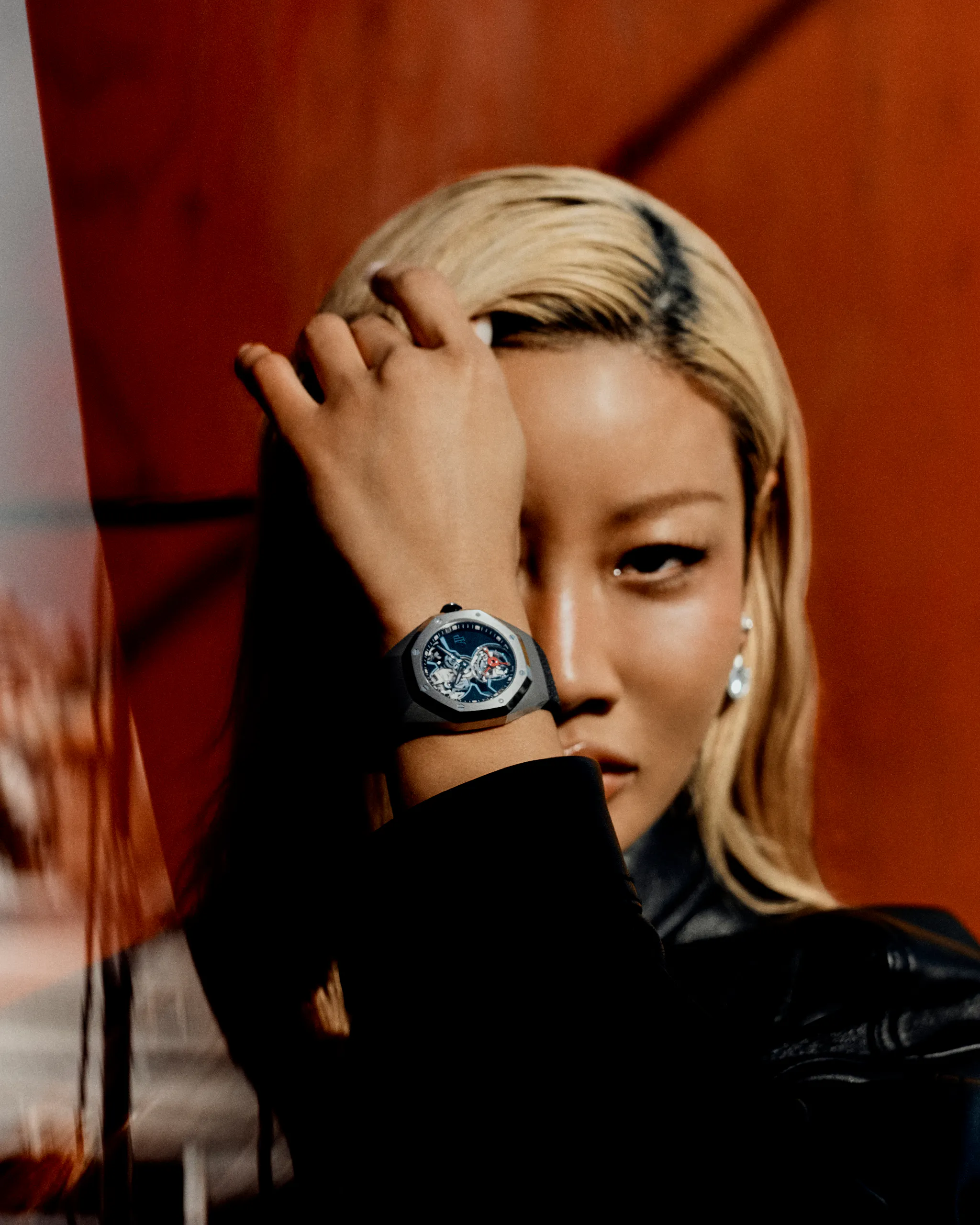
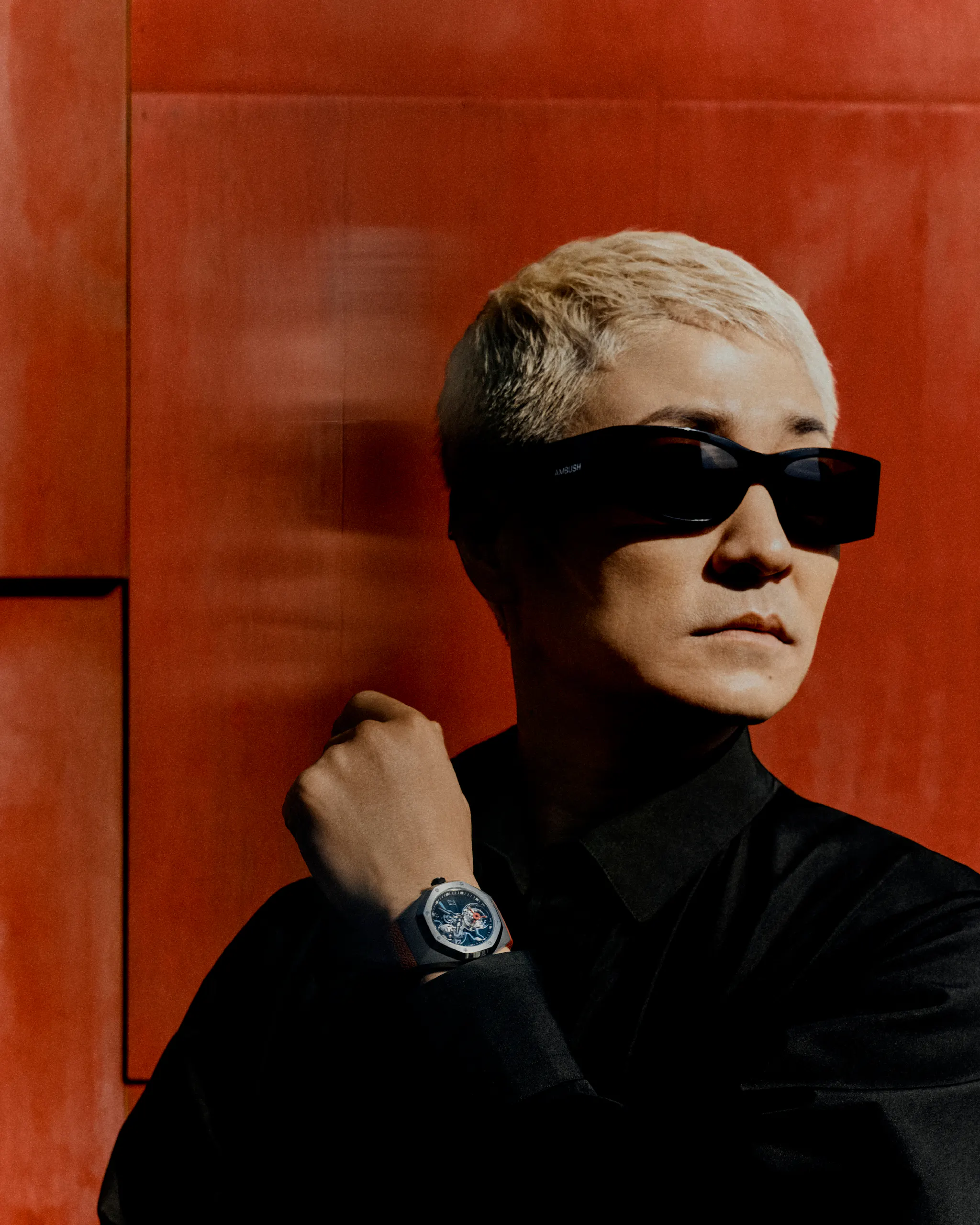
The watch that emerged from the collaboration feels, in the best possible way, like a distillation, a Royal Oak Concept reinterpreted not through maximalism but through its opposite: an openworked architecture that strips away surface to reveal what lies beneath, inviting you to slow down and look closer rather than be immediately dazzled. The black aventurine dial opens onto the movement itself, its depth and texture a reminder that the most interesting things tend to reveal themselves gradually. At its centre, a red flying tourbillon functions as both heartbeat and anchor — the force that keeps everything in motion while grounding it in something essential. For Verbal, red has always carried particular weight; the tourbillon cage evokes the Earth's core, the origin point, the source from which everything else radiates. And in keeping with the collaboration's broader philosophy, the piece resists the usual language of exclusivity: the first in its size to feature an interchangeable strap system, it is, in the most literal sense, built to adapt.
Die Royal Oak Concept, die der Zusammenarbeit entsprang, ist eine Art Destillation – ein Zeitmesser, der nicht durch Ergänzung neu interpretiert wird, sondern durch ihr Gegenteil. Ein schwarzes, skelettiertes Aventurin-Zifferblatt, das freilegt, was oft verborgen bleibt, das einlädt, genauer hinzuschauen, daran erinnern soll, dass das Interessanteste sich selten sofort zeigt. In seinem Zentrum ein roter fliegender Tourbillon, Herzschlag und Anker zugleich, die Kraft, die alles in Bewegung hält und gleichzeitig erdet. Wieso rot? Für Verbal hatte die Farbe schon immer eine besondere Bedeutung. Es steht für den Erdkern, für Ursprung und Energie, für den Punkt, von dem alles ausgeht. Der rote Tourbillonkäfig trägt genau das in sich. Und ganz im Sinne der Kollaboration verweigert sich die Uhr in einem gewissen Sinne dem Gedanken der Exklusivität: Als erstes Modell dieser Grösse mit einem auswechselbaren Armbandsystem ist sie, im wahrsten Sinne, für alle gemacht.


There is a particular kind of creative legacy that accumulates quietly in the slow work of people who always knew what they were doing even when the industry hadn't caught up yet. Yoon and Verbal have been building theirs since a chance meeting in a Boston church, through a leap across the Pacific, through two decades of moving between worlds that others insisted on keeping separate. Audemars Piguet has been on its own version of that journey — a 150-year-old manufacture that has remained curious, remained restless, always the first among its peers to look outward and mean it. When the two paths converge, the result isn't as much a collaboration in the conventional sense as it is a recognition — of two creative forces, each shaped by the conviction that the most essential things reveal themselves only when you're willing to look closer.
The watch is the proof of that. Stripped back, opened up, and more alive for it.
audemarspiguet.com
Manche kreativen Vermächtnisse entstehen im Stillen, im beharrlichen Schaffen von Menschen, die immer wussten, was sie taten, auch wenn die Industrie noch nicht so weit war. Yoon und Verbal haben ihres seit einer zufälligen Kirchenbegegnung in Boston aufgebaut, Schritt für Schritt, über den Pazifik hinweg, über zwei Jahrzehnte und in Welten, die andere nie zusammengedacht hätten. Audemars Piguet ist auf seine eigene Art denselben Weg gegangen, eine 150 Jahre alte Manufaktur, die immer neugierig, immer rastlos blieb, immer die erste unter ihresgleichen, die den Blick nach aussen gerichtet hat und wirklich sah, was sie vorfand. Wenn diese beiden Wege zusammenfinden, ist das Ergebnis weniger eine Kollaboration im klassischen Sinne als eine gegenseitige Anerkennung. Diejenige zweier kreativer Kräfte, die wissen, dass das Wesentliche sich nur demjenigen zeigt, der bereit ist, genauer hinzuschauen.
Die Uhr ist der Beweis. Reduziert, offen – und gerade deshalb lebendig.
audemarspiguet.com