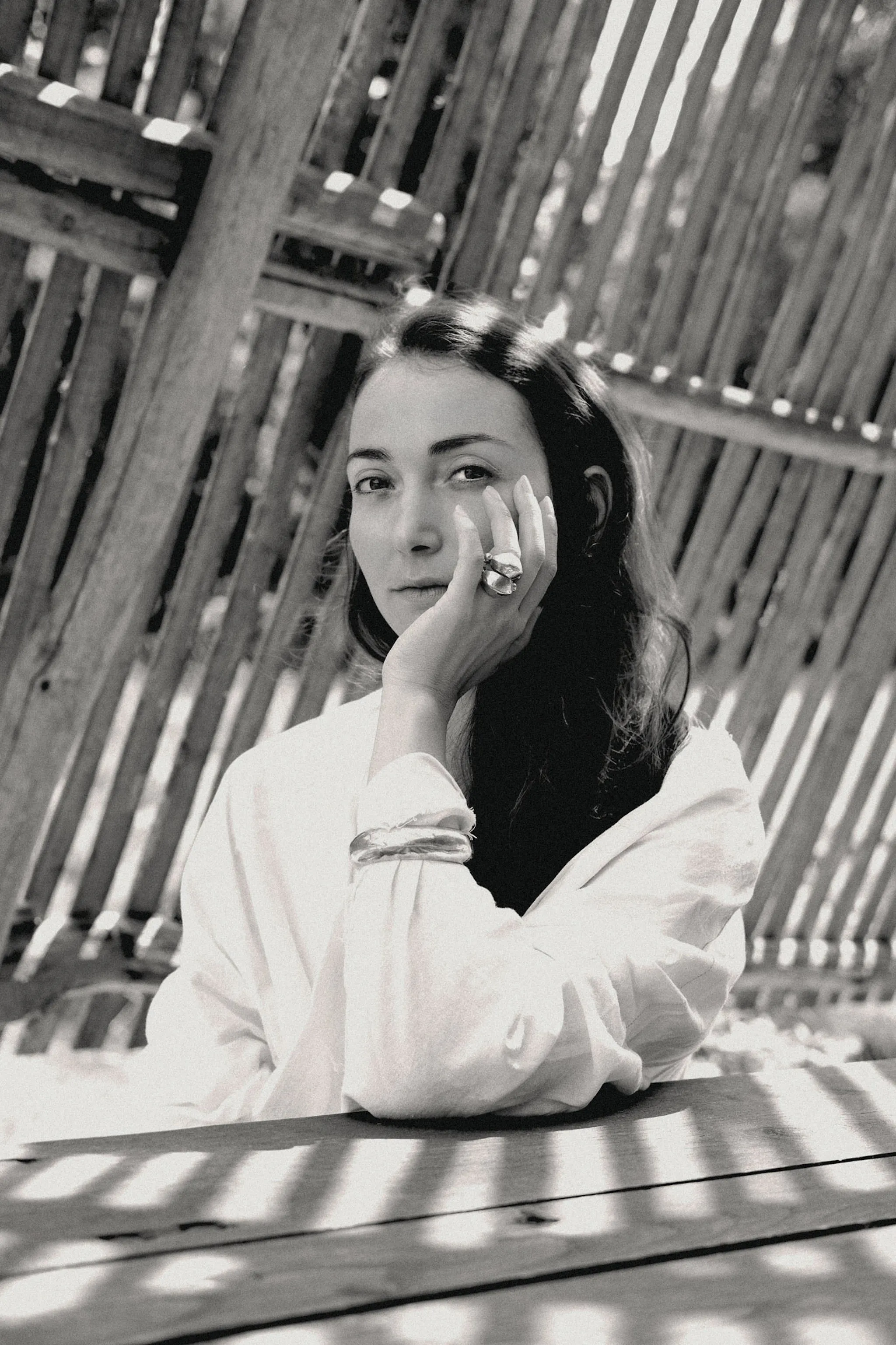
Walking into Ezgi Turksoy's canal house in the heart of Amsterdam on a bright summer day, the sky a vast blue, it seems like it has started to snow. Tiny white wisps drop from the branches of a large tree, feathering down onto the street. I see it unfold through the large windows in her living room. Today I’m back in the city I grew up in but haven't lived in for years. And that picture you would paint of Amsterdam canals, the almost cinematic feel to it, I now realise is something I didn’t always see when I was a part of it.
The tree, it turns out, is an elm. Neither Ezgi nor I knew this, but the spectacle has a name: spring snow. And Amsterdam happens to be the elm capital of the world, home to over 75,000 of them. They've been following me, she laughs. I've moved around quite a bit, and wherever I go there's always this tree. Symbolism runs through Ezgi's life. And her work. Her wearable art brand, Manà, came about during a transitional moment, about two years ago
Beim Betreten von Ezgi Turksoys Grachtenhaus im Herzen Amsterdams an einem hellen Sommertag – der Himmel ein weites Blau – scheint es zu schneien. Winzige weisse Flocken lösen sich von den Ästen eines grossen Baumes und segeln auf die Strasse hinab. Ich beobachte das Schauspiel durch die hohen Fenster ihres Wohnzimmers. Heute bin ich zurück in der Stadt, in der ich aufgewachsen bin, aber seit Jahren nicht mehr lebe. Und dieses Bild, das man sich von Amsterdamer Grachten malt, diese fast cineastische Anmutung, habe ich, so wird mir jetzt klar, nicht immer wahrgenommen, als ich noch ein Teil davon war.
Der Baum, so stellt sich heraus, ist eine Ulme. Weder Ezgi noch ich wussten das – doch das Schauspiel hat einen Namen: Frühlingsschnee. Und Amsterdam ist mit über 75000 Exemplaren die Ulmenhauptstadt der Welt. Die Ulmen verfolgen mich, sagt Ezgi. Ich bin viel umgezogen, und wohin ich auch gehe, dieser Baum ist immer da. Symbolik zieht sich durch Ezgis Leben – und durch ihre Arbeit. Ihr Wearable-Art-Label Manà entstand vor etwa zwei Jahren, in einem Moment des Aufbruchs.



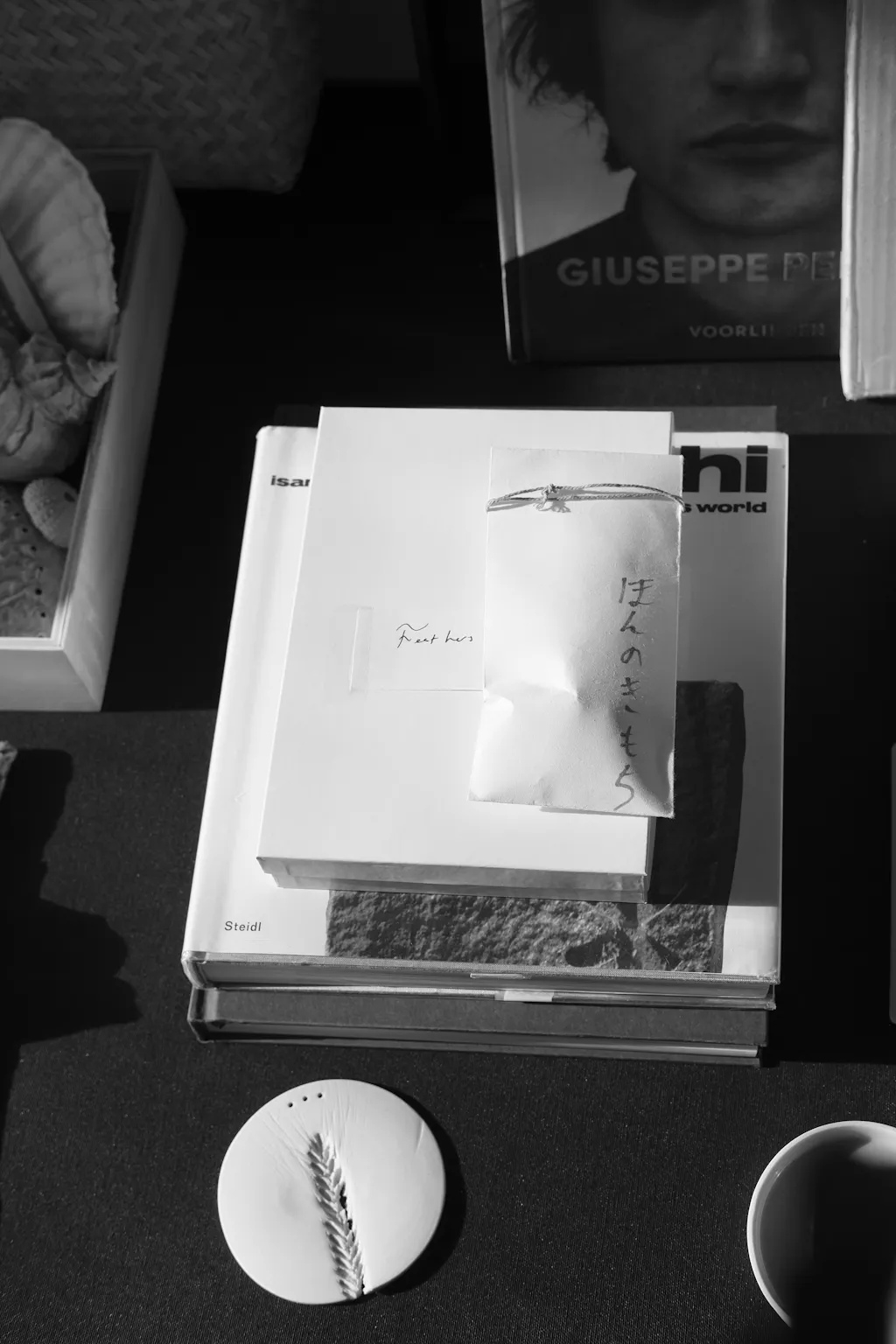
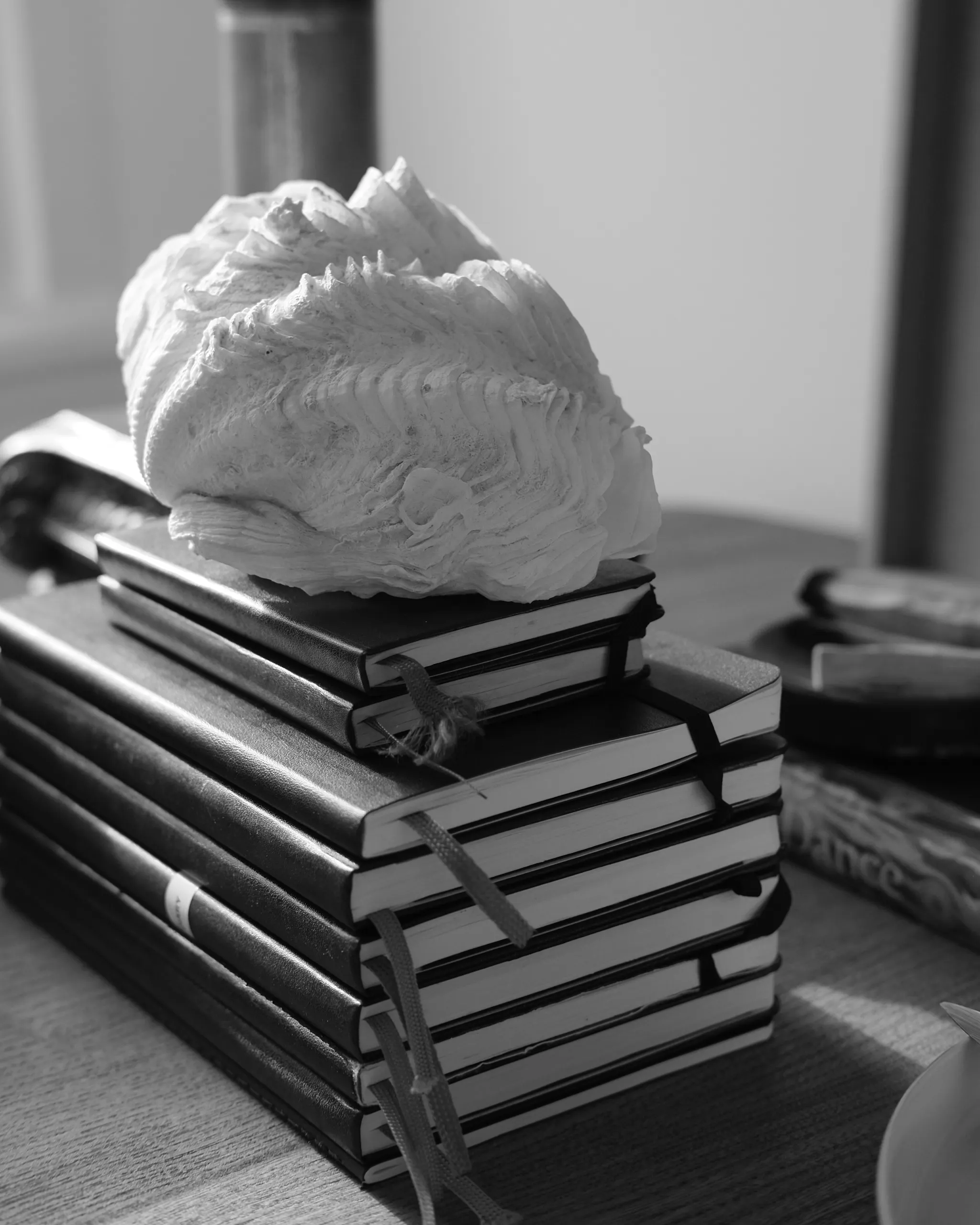
She has just moved into this new apartment. A new chapter, though somehow it feels as if she has always lived here. Her universe reveals itself through the objects around her: shells she later casts, stones, flowers, dried leaves, ceramic pieces, stacks of books and small keepsakes gathered on her travels. I don’t really collect things for their material value, she says. It has to provoke an emotional reaction. The result feels almost like a cabinet of curiosities, though never a static one. Everything circulates, she adds. Next week, it could look entirely different.
In front of the table at the centre of the space sits a daybed and a few bulbous Maarten Baas Clay stools. Mini Schnauzer Watson has claimed her spot on the rug beside them. She’s calm now, but don’t be fooled. Usually she’s quite the character. Ezgi pours black coffee into small cups, steam softly rising from each. Next to them in wooden bowls: floss halva, Turkish cotton candy, its spun threads dissolving into the deep, almost savoury sweetness of tahini. And that’s where we begin, with her childhood in Istanbul.
KVW How did Turkey shape you?
ET Looking back, I now see how Istanbul influenced me much more than I realised at the time. It is a city full of contrasts and dualities between East and West, tradition and modernity, chaos and beauty. There is a depth of culture there you can feel in your veins. Istanbul life is also unpredictable, politically and socially, and that builds stamina. Simultaneously, living in that kind of intensity makes you very sensitive to what surrounds you. Or at least, it did me.
Die Wohnung in Amsterdam hat Ezgi vor Kurzem erst bezogen. Ein neues Kapitel – und doch hat man das Gefühl, sie habe schon immer hier gelebt. Ihr Universum erschliesst sich durch die Objekte um sie herum: Muscheln, von denen sie später Abgüsse macht, Steine, Blumen, getrocknete Blätter, Keramik, Bücherstapel, kleine Mitbringsel ihrer Reisen. Das Ergebnis erinnert fast an eine Wunderkammer – aber nie an eine starre. Alles zirkuliere, sagt Ezgi. Nächste Woche könnte es hier völlig anders aussehen.
Vor einem Tisch in der Mitte des Raums stehen ein Daybed und einige bauchige Clay-Hocker von Maarten Baas. Mini-Schnauzer Watson hat sich ihren Platz auf dem Teppich daneben gesichert. Ezgi giesst schwarzen Kaffee in kleine Tassen, aus denen der Dampf aufsteigt. Daneben, in Holzschälchen: Floss-Halva, türkische Zuckerwatte, deren gesponnene Fäden sich in der tiefen, fast herzhaften Süsse des Tahinis auflösen. Und genau dort beginnen wir unser Gespräch – bei ihrer Kindheit in Istanbul.
KWV Inwiefern hat dich deine Kindheit in der Türkei geprägt?
ET Viel stärker, als mir damals bewusst war. Istanbul ist eine Stadt der Gegensätze: Ost und West, Tradition und Moderne, Chaos und Schönheit koexistieren in einer Spannung, die man richtiggehend körperlich spürt. Das Leben dort ist unberechenbar – politisch wie gesellschaftlich. Diese Intensität härtet ab und macht einen gleichzeitig sehr sensibel auf alles, was einen umgibt. Mich zumindest hat sie das.
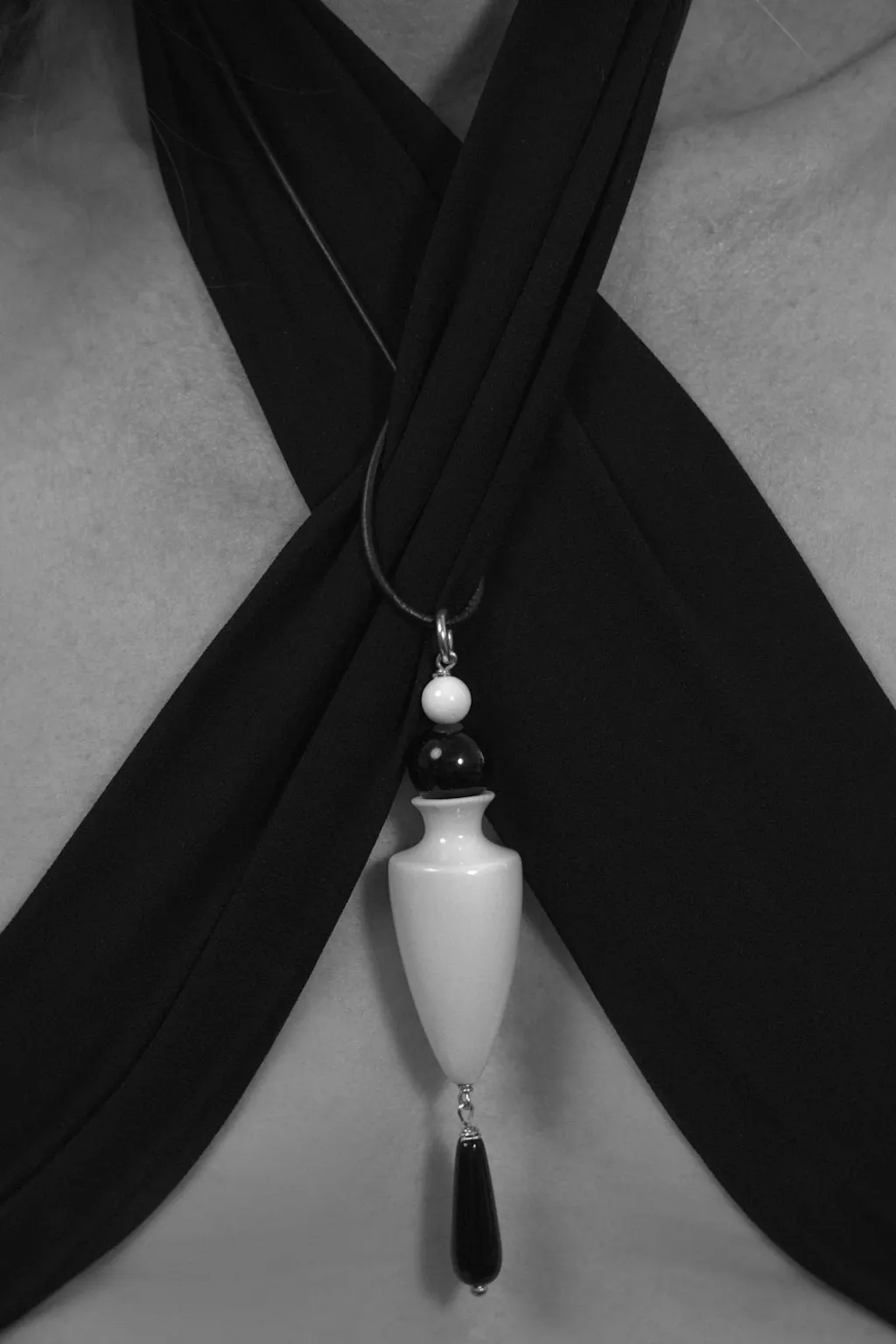
Image in Collaboration with Nikè van de Waal
KVW Sensitive how?
ET In Turkish culture, objects carry meaning beyond their physical form. Jewellery was never just decorative; gold bracelets and coins given at weddings, evil eye charms worn almost like personal rituals. Those were probably my first experiences of understanding objects as something much more than accessories. But there is also a social side to this sensibility. Istanbul may be large, but community-wise it is small. Everyone knows each other; it is an intense, tight-knit culture. There are codes to follow. So, at 18, I decided to move to London to study Design at Central Saint Martins and complete my Masters in History of Contemporary Design at Sotheby's Institute of Art. That distance was good for me.
KWV Wie äussert sich diese Sensibilität?
ET In der türkischen Kultur tragen Objekte eine Bedeutung, die über ihre physische Existenz hinausgeht. Schmuck ist nie nur dekorativ: Goldarmreife und -münzen, die bei Hochzeiten verschenkt werden, Evil-Eye-Amulette, die man fast wie ein persönliches Ritual trägt. Man lernt früh, Objekte als weit mehr als Accessoires zu verstehen. Und auch das Zusammenleben ist durchzogen von Bedeutung unter der Oberfläche. Istanbul mag eine Millionenstadt sein, doch gesellschaftlich ist es ein Dorf. Alle kennen sich, es ist eine intensive, eng verwobene Gemeinschaft, mit Codes, die man zu befolgen hat. Mit 18 entschied ich mich deshalb, nach London zu ziehen, um am Central Saint Martins Design zu studieren und anschliessend meinen Master in History of Contemporary Design am Sotheby's Institute of Art zu absolvieren. Diese Distanz hat mir gutgetan.
KVW In what way?
ET I was different in Istanbul from who I became in London. The distance from family, from that society, studying at art school surrounded by people from all over the world. It gave me a new perspective and a space to develop a different part of myself. That's what I love about being in different places. You rediscover yourself.
KVW What is home to you?
ET I always say I was born in Istanbul, but I grew up in London, because that’s how it feels to me. Then I found myself in the Netherlands, where I moved to be with my former partner, furniture designer Maarten Baas, whom I met during a workshop in the south of France. The town where we lived, Utrecht, felt very different from Amsterdam, where I moved just a few months ago. I am not really sure where I belong now, but I quite like it that way.
KVW How so?
ET In a culture as strong as the Turkish one, it isn't always easy to just be your most authentic self. As humans, I think it is part of our survival that we adapt to our environments. But here in Amsterdam it almost feels like being suspended in a sort of liminal space, where I don't have to be anything really. And when you're still discovering a place, your identity can still shift and form. There are no expectations; nobody knows who you are. I think that's exactly where we grow and transform. I really love that sense of freedom.
KVW Would you ever move back to Istanbul?
ET Not yet. But when I think about it professionally, the craft scene there is incredible. The artisans you meet — they are so skilled, and you can learn so much from them. There is a generational know-how when it comes to craft that gets passed down, which is sadly harder and harder to find here in Europe.
KVW Inwiefern?
ET In Istanbul war ich eine andere als die, die ich in London wurde. Die Distanz zur Familie, zur Türkei, das Studieren mit Menschen aus aller Welt – das alles hat mich verändert, mir Raum gegeben, neue Seiten zu entfalten. Das ist es, was ich am Leben in der Fremde so liebe. Man entdeckt sich neu.
KVW Hat das Konzept Heimat denn überhaupt eine Bedeutung für dich?
ET Ich sage immer, ich bin in Istanbul geboren, aber in London aufgewachsen. Später folgte ich meinem damaligen Partner, dem Möbeldesigner Maarten Baas, den ich bei einem Workshop im Süden Frankreichs kennengelernt hatte, in die Niederlande. Utrecht, die Stadt, in der wir lebten, fühlte sich ganz anders an als Amsterdam, wohin ich vor wenigen Monaten gezogen bin. Wo ich hingehöre, weiss ich gerade nicht so genau – aber ich mag das eigentlich ganz gern so.
KVW Was gefällt dir daran?
ET In einer Kultur, die so stark ist wie die türkische, ist es nicht immer einfach, sich selbst zu sein. Als Menschen passen wir uns unserer Umgebung an – ich glaube, das gehört zu unserem Überlebensinstinkt. Aber hier in Amsterdam fühlt es sich fast an, als würde ich schweben, in einem Zwischenraum, in dem ich nichts sein muss. Während man einen Ort noch entdeckt, kann sich die eigene Identität verschieben, formen. Niemand kennt einen, niemand hat Erwartungen. Genau dadurch, glaube ich, wachsen wir – und diese Freiheit liebe ich.
KVW Kannst du dir vorstellen, irgendwann nach Istanbul zurückzukehren?
ET Noch nicht. Obwohl es beruflich betrachtet Sinn ergeben würde. Die Kunsthandwerkerinnen und Kunsthandwerker, denen man dort begegnet – sie sind so versiert, man kann so viel von ihnen lernen. Dieses generationenübergreifende Wissen ist in Europa leider immer schwerer zu finden.

KVW What does your creative process look like?
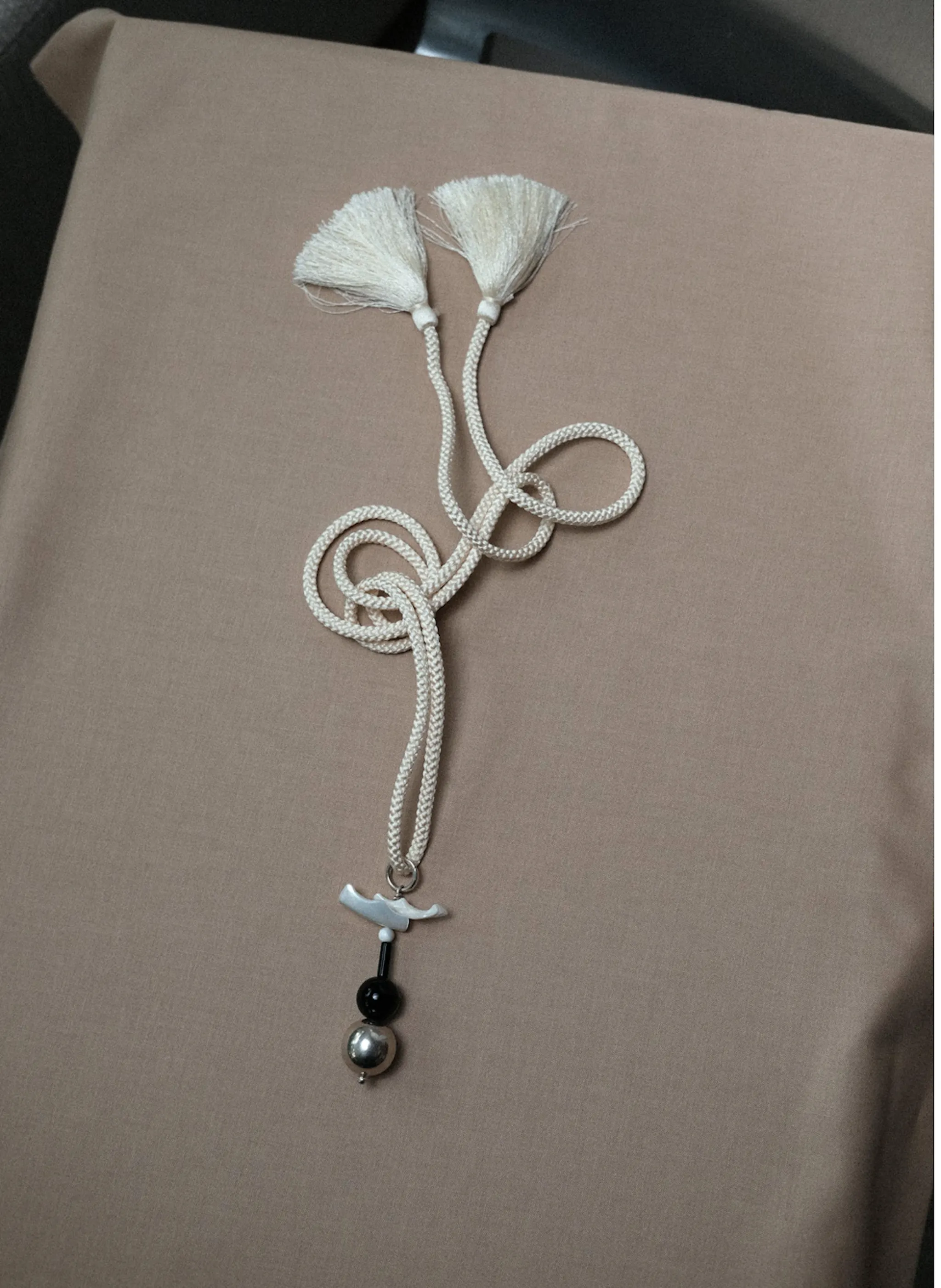
ET The process usually begins with a feeling rather than a design. It can start with a story, a shell I found, a texture, a sentence from a book. I collect constantly, and I spend a lot of time researching archetypal meanings. Then I begin making. I work with ceramics, sterling silver, and gemstones, and I love the tension between them: the softness of ceramics against the permanence of silver and stone. I always think of my pieces as talismans first. They need to carry a certain energy.
KVW Do you sketch?
ET Not really. I need to touch things, feel my way through them. Ceramics taught me a lot because it forces you to surrender a little. I can guide it, but there is always an element of surprise, some imperfection, and I love that. If I do draw, it is more automatic drawing. Have you heard about it?
KVW I haven’t, actually.
ET The surrealists used to do this. You take a pen, let your hand do the work, don't think, don't plan. It is quite a meditational process. The idea is that it connects to your subconscious. Not the first page, but by the twentieth, something really comes out.
KVW Wie sieht denn dein eigener kreativer Prozess aus?
ET Der Prozess beginnt meist mit einem Gefühl – das kann eine Geschichte sein, eine Muschel, die ich gefunden habe, eine Textur, ein Satz aus einem Buch. Ich sammle ständig und verbringe viel Zeit damit, archetypische Bedeutungen zu erforschen. Geht es an die Kreation, arbeite ich mit Keramik, Sterlingsilber, Edelsteinen – und ich liebe die Spannung zwischen ihnen: die Weichheit der Keramik gegen die Beständigkeit von Silber und Stein. Meine Designs sind wie Talismane: Sie müssen eine bestimmte Energie in sich tragen.
KVW Zeichnest du auch?
ET Selten. Ich muss Dinge berühren, mich durch sie hindurchtasten. Keramik hat mich diesbezüglich viel gelehrt, weil sie mich zwingt, loszulassen. Ich kann sie lenken, aber es gibt immer eine Überraschung, eine Unvollkommenheit. Wenn ich zeichne, dann im Sinne des Automatismus. Sagt dir das etwas?
KWV Nicht wirklich.
ET Die Surrealisten haben das praktiziert: Man nimmt einen Stift, lässt die Hand arbeiten, denkt nicht, plant nicht. Es ist ein fast meditativer Prozess – die Idee ist, dass er eine Verbindung zum Unterbewusstsein herstellt. Nicht auf der ersten Seite, aber vielleicht auf der zwanzigsten taucht plötzlich etwas auf.
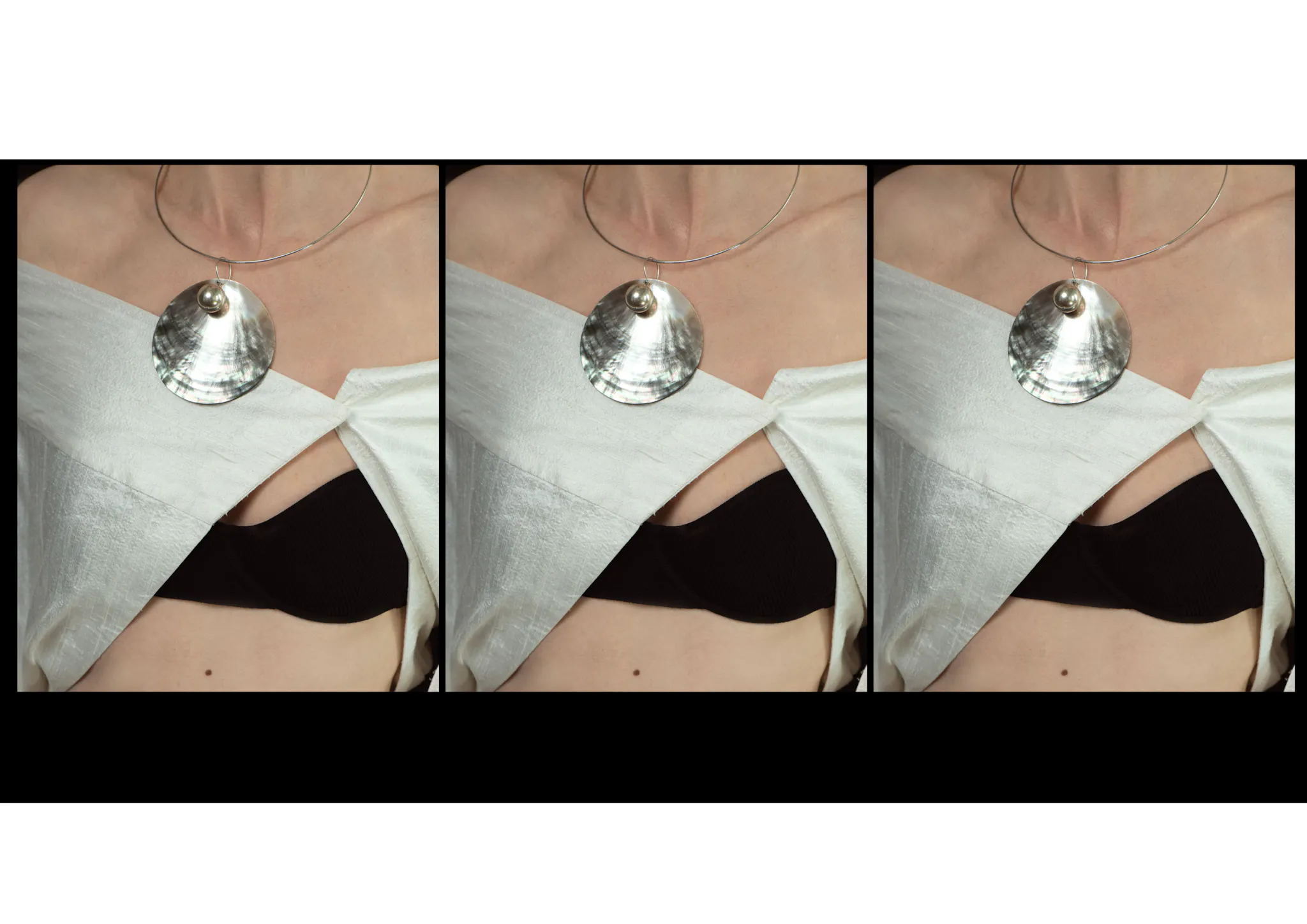
Image in Collaboration with Nikè van de Waal
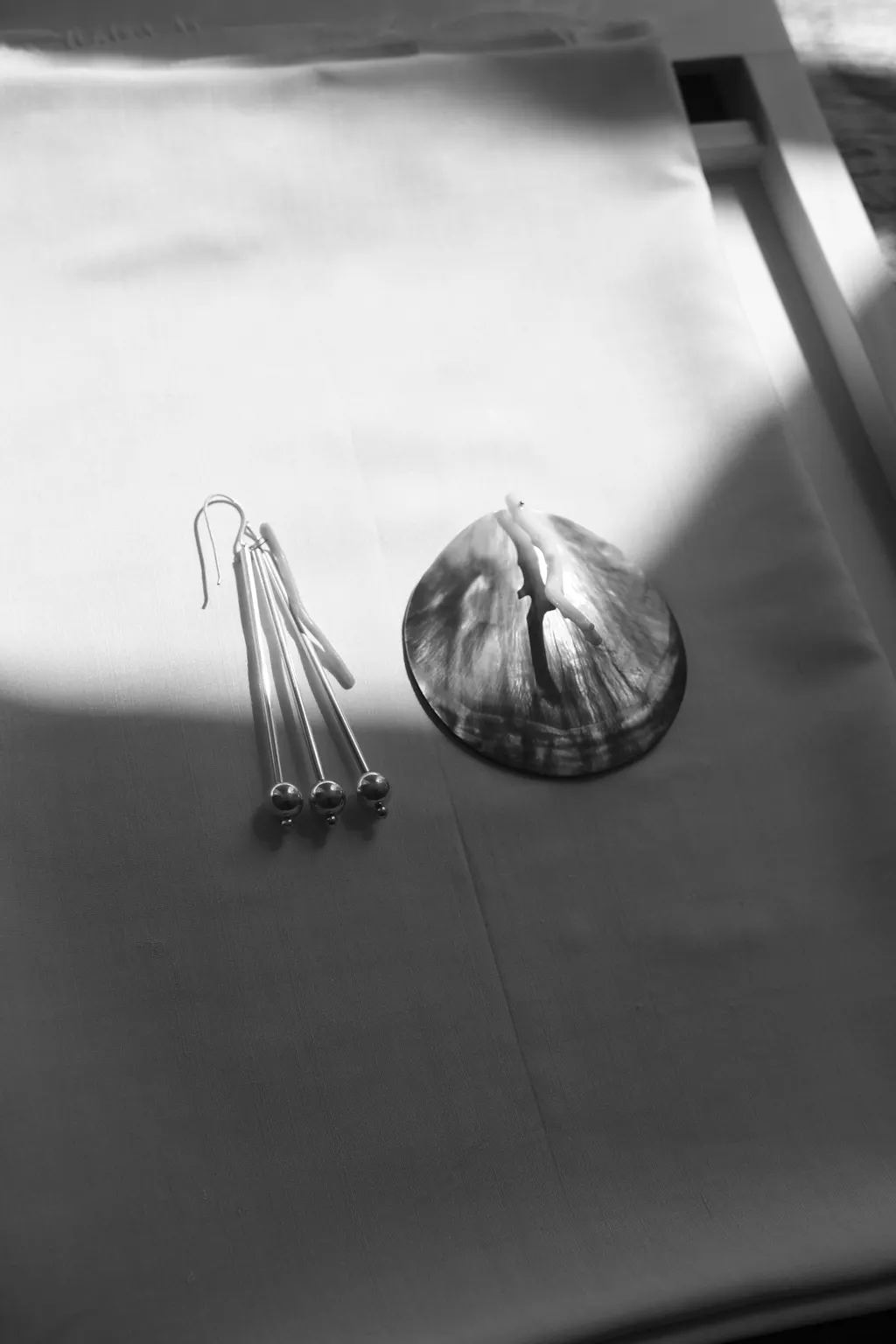
Ezgi picks up a shell amulet from the table and offers it to me.
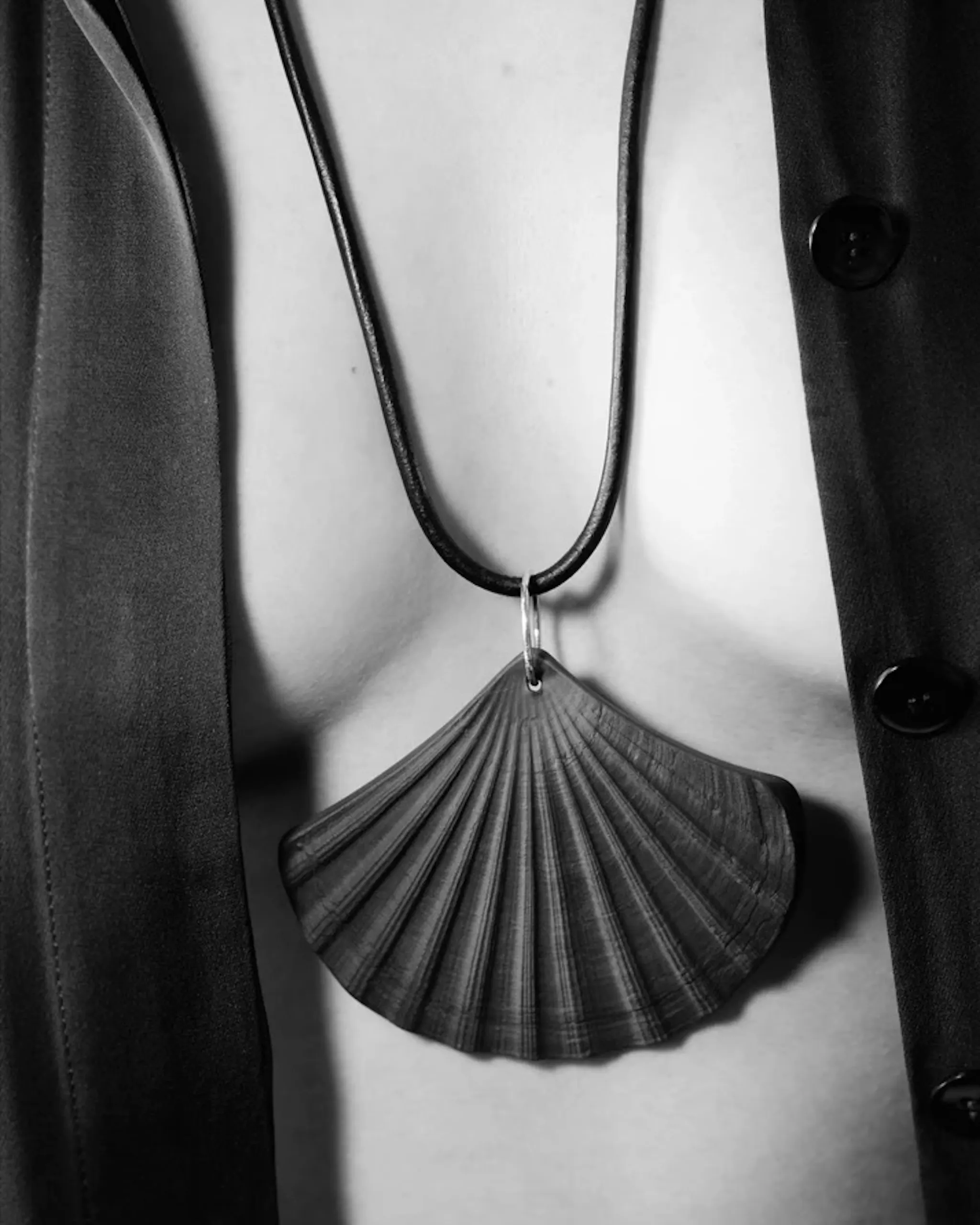
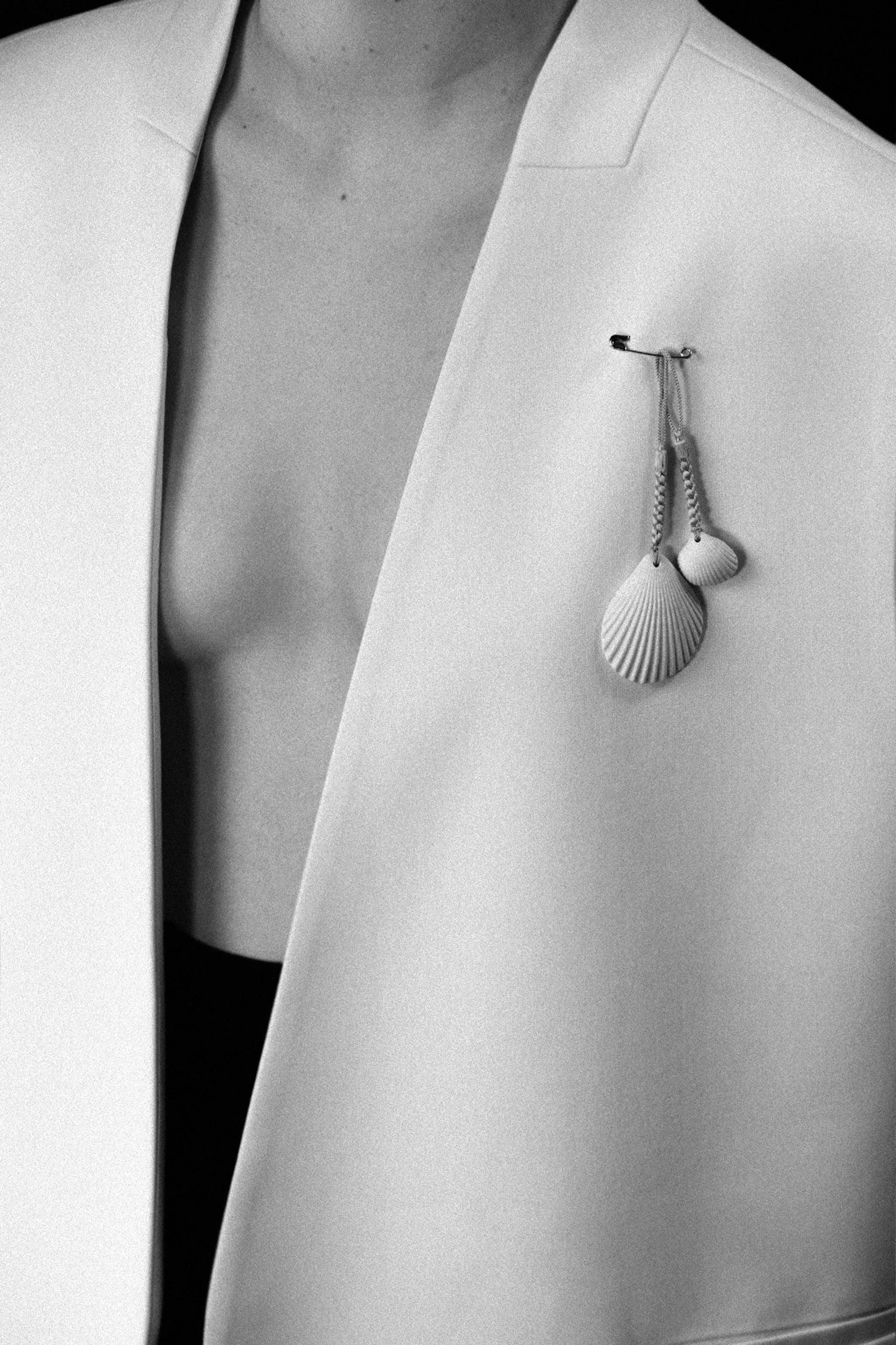
ET Would you like to have it? I made it for you. At the moment, I feel especially connected to these shell amulets because they hold everything that Manà represents: symbols of protection, femininity, transformation and intuition. They feel archetypal, as if they have always existed. I can only use the mould for them five or six times at most, then I have to remake it to preserve the detailing.
KVW And what is this beautiful glass vessel next to your shell amulet?
ET I made it. I work across a lot of different mediums. When I applied to Central Saint Martins, I actually got in because of my photography. I don’t think I am necessarily brilliant at any one thing, but that is often when the most beautiful surprises happen. I am not really a craftsman, because I am not interested in perfection. And I don’t really call myself a designer either, because my mind doesn’t work like that. I never begin with a clear idea. Like I said, I start with a feeling and somehow end up somewhere. I make, make, make, then eliminate most of it until the right thing remains. That’s the journey, the artist’s struggle, and I think that process is super important.
Ezgi greift nach einem Muschelamulett und reicht es mir herüber.
ET Möchtest du es haben? Ich habe es für dich gemacht. Aktuell fühle ich mich diesen Muschelamuletten besonders verbunden, weil sie alles verkörpern, wofür Manà steht: Schutz, Weiblichkeit, Transformation, Intuition. Sie wirken archetypisch – als hätten sie schon immer existiert. Die Form hält höchstens fünf oder sechs Abgüsse, ich muss sie immer wieder neu anfertigen, um die Feinheiten zu bewahren.
KVW Und was ist dieses wunderschöne Glasgefäss neben deinem Muschelamulett?
ET Auch eine meiner Kreationen. Ich arbeite in diversen Disziplinen. Bei Central Saint Martins wurde ich eigentlich wegen meiner Fotografie angenommen. Ich glaube nicht, dass ich in irgendetwas besonders brillant bin. Ich bin kein Handwerker im eigentlichen Sinne, weil mich Perfektion nicht interessiert. Und Designerin würde ich mich auch nicht wirklich nennen, weil mein Kopf nicht so funktioniert. Ich beginne nie mit einer klaren Idee, sondern starte mit einem Gefühl und lande irgendwie irgendwo. Ich mache, mache, mache – und eliminiere dann das meiste davon, bis das Richtige übrigbleibt. Das ist die Reise, der Kampf des Künstlers, und ich glaube, dieser Prozess ist wichtig.
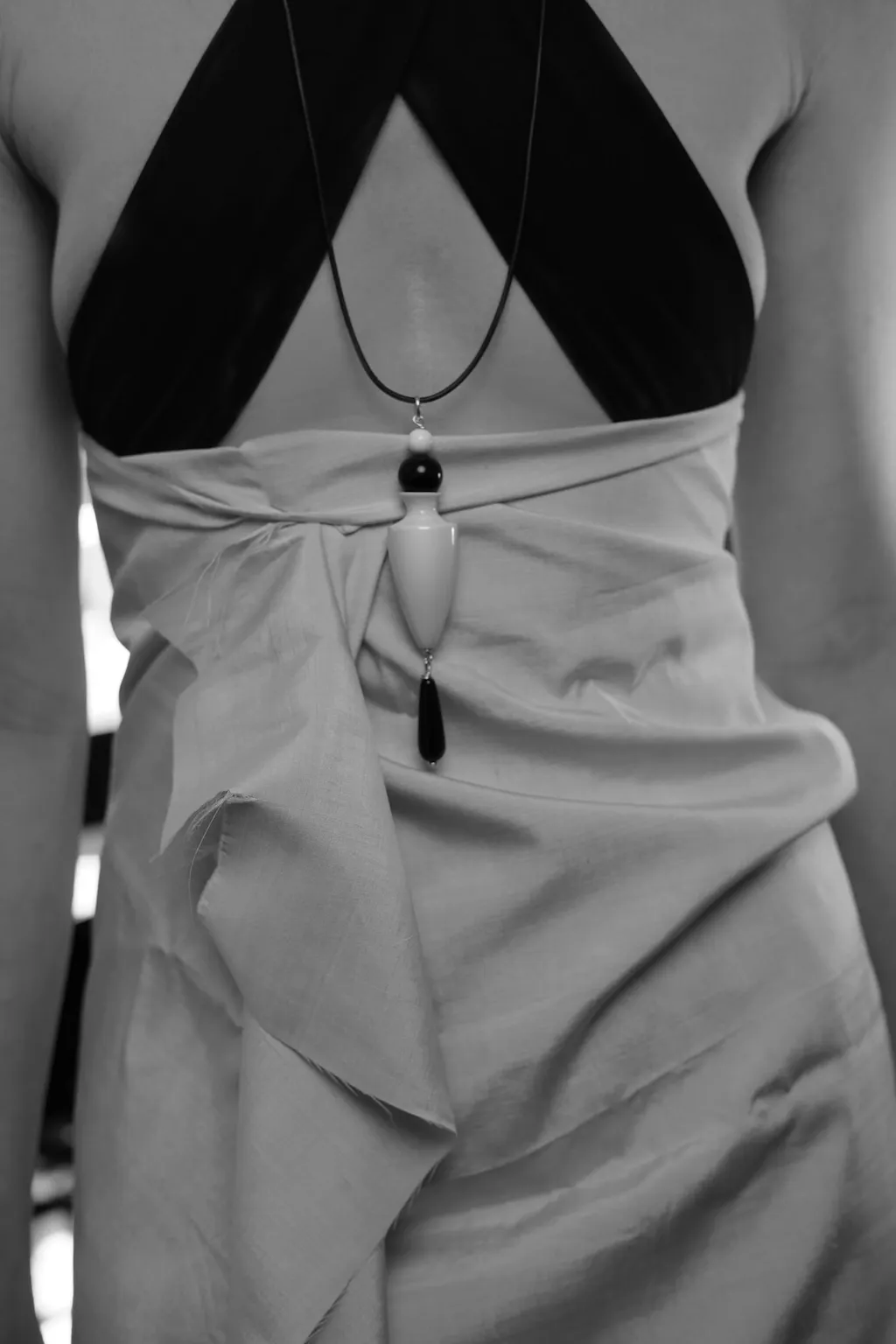
Image in Collaboration with Nikè van de Waal
KVW What headspace do you need to be in to create?
ET I have to consciously remind myself to carve out time and return to what feels real. Drowning out the noise is difficult, especially with social media. I do everything on my own, and if you disappear for a few days, the algorithm goes wild and engagement drops. Sadly, it is part of the reality of it all. But sometimes I leave my phone behind and go to the forest. It is the best way to return to myself. Research is also a big part of my process. For me, function is inseparable from story. The emotional and intellectual world behind an object matters just as much as the object itself. I am very curious, and when I dive into a subject, it feels as though I find myself on another planet.
KVW In welcher geistigen Verfassung musst du dich befinden, um kreativ zu sein?
ET Ich muss mir bewusst die Zeit nehmen und zu dem zurückkehren, was sich echt anfühlt. Den Lärm auszublenden, ist schwierig, besonders mit Social Media. Wenn man sich ein paar Tage zurückzieht und inaktiv wird, spielt der Algorithmus verrückt und das Engagement sinkt sofort. Und trotzdem, manchmal lasse ich mein Handy zurück und gehe in den Wald – das ist der beste Weg, um zu mir selbst zurückzufinden. Recherche ist ebenfalls ein wichtiger Teil meines Prozesses. Für mich sind Funktion und Geschichte untrennbar miteinander verbunden. Die emotionale und intellektuelle Welt hinter einem Objekt zählt genauso viel wie das Objekt selbst. Ich bin sehr neugierig, und wenn ich mich in ein Thema vertiefe, ist es, als würde sich mir eine ganz neue Welt eröffnen.
KVW Tell me about that research.
ET That's why I initially wanted to work for auction houses. I was really into research, spending hours in London's Victoria & Albert Library, understanding the dynamics of objects, people, value. I had this dream of becoming a specialist in contemporary and collectible design. But I quickly realised it wasn't for me. The hierarchy was rigid, and the freedom I wanted would take years to earn, if ever. But it is where I fell in love with writing and storytelling.
Ezgi places a book on the table.
ET This is my bible, (laughs) Women Who Run With The Wolves. I have all these notes and bits and bobs in there. I take it literally everywhere, every time I travel. Sometimes I just open a chapter and get a message from it.
KVW What kind of message?
ET The wild woman archetype is not about being wild, or even about being a woman. It's about being authentic and connected with your instincts and your intuition. At that time, about four years ago, I felt a bit lost. I was working so much, always wanted to keep up, allowed myself no time to slow down. I was reading Carl Gustav Jung at that point, too. He talks about the collective unconscious, something you are born with, shared across humanity through cultures. It communicates itself through archetypes and symbols. When you see a shell, something is triggered in your subconscious, and the same thing is triggered in somebody across the ocean. I find that really beautiful; and comforting. The name Manà I found in Women Who Run With the Wolves. It describes a magical quality, an aura, surrounding and emanating through nature, people, objects and places. Serendipitously, in Turkish it simply means meaning.
KVW Erzähl mir mehr von diesen Recherchen.
ET Sie waren der Grund, warum ich ursprünglich für Auktionshäuser arbeiten wollte. Recherchieren hat mich schon immer fasziniert. Ich habe Stunden in der Bibliothek des Victoria-and-Albert.Museums verbracht, um darüber zu lesen, wie Objekte, Menschen und Wert zusammenhängen. Ich hegte diesen Traum, mich auf zeitgenössisches und Sammler-Design zu spezialisieren. Doch schnell spürte ich, dass diese Welt nicht die meine war. Die Hierarchien sind zu streng, und die Freiheit, die ich mir wünschte, hätte ich mir – wenn überhaupt – über Jahre erarbeiten müssen. Doch aus dieser Erfahrung heraus ist meine Liebe zum Schreiben und zum Storytelling geboren.
Ezgi greift nach einem Buch.
ET Dies hier ist meine Bibel, (lacht) Women Who Run With The Wolves. Ich habe darin lauter Notizen und kleine Merkzettel angebracht. Ich nehme das Buch überallhin mit, auf jede Reise. Manchmal schlage ich einfach ein Kapitel auf, und es spricht genau zu dem, was ich gerade brauche.
KVW Zum Beispiel?
ET Der Archetyp der wilden Frau hat nichts damit zu tun, wild zu sein – oder eine Frau. Es geht darum, authentisch und mit den eigenen Instinkten, der eigenen Intuition verbunden zu bleiben. Damals, vor etwa vier Jahren, fühlte ich mich ziemlich verloren. Ich habe so viel gearbeitet, erlaubte mir nie, mal innezuhalten. Zu dieser Zeit habe ich auch Carl Gustav Jung gelesen. Er spricht viel vom kollektiven Unbewussten, etwas, das einem in die Wiege gelegt wird, der gesamten Menschheit, über alle Kulturen hinweg. Und es äussert sich nicht zuletzt durch Archetypen und Symbole. Sieht man eine Muschel, wird etwas in unserem Unterbewusstsein ausgelöst – und genau dasselbe geschieht bei jemandem auf der anderen Seite des Ozeans. Ich finde das wunderschön, und tröstlich zugleich. Den Namen Manà habe ich in Women Who Run With the Wolves entdeckt. Er beschreibt eine magische Qualität, eine Aura, die die Natur, Menschen, Objekte und Orte umgibt und durchdringt. Wie es der Zufall will, bedeutet er auf Türkisch schlicht Bedeutung.
KVW So is this how the idea of Manà first took shape?
ET It did. A year prior I had ended the business with my sister, and I gave myself a year to discover the next steps. I could have become a gardener, a photographer, a ceramicist — all things I love. I really didn’t know. Then I read this and thought: I don’t know what it’s going to become, but the name is going to be Manà.
KVW Manà got picked up quite swiftly, I feel.
ET It attracted a certain vibration of people, I think. There is so much mass production now. People long for something with more depth to it, where you can feel the hand of the maker. But it felt very vulnerable in the beginning.
KVW Vulnerable in what way?
ET It is pretty exposing, putting yourself out there like that. I started my Instagram account as a sort of visual diary, and I had no clue if it would even remotely land with people. But it gained momentum quickly indeed, and that makes me feel so grateful.
KVW War das der Moment, in dem die Idee von Manà geboren wurde?
ET Genau. Ein Jahr zuvor hatte ich das gemeinsame Label mit meiner Schwester aufgelöst und mir selbst zwölf Monate Zeit gegeben, um herauszufinden, was als Nächstes kommt. Ich hätte Gärtnerin werden können, Fotografin, Keramikerin – alles Dinge, die ich liebe. Dann las ich Manà und dachte: Ich weiss nicht, was daraus wird, aber es wird diesen Namen tragen.
KVW Was aus Manà wurde, erregte schnell Aufmerksamkeit.
ET Es hat eine bestimmte Art von Menschen angesprochen, glaube ich. Es gibt heute so viel Massenproduktion. Viele von uns sehnen sich nach etwas mit mehr Tiefe, in dem man die Hand der Macherin spürt. Und doch fühlte ich mich zu Beginn sehr exponiert.
KWV Inwiefern?
ET Es macht einen sehr angreifbar, sich zu zeigen. Ich habe meinen Instagram-Account als eine Art visuelles Tagebuch begonnen, ohne jede Ahnung, ob und wie er ankommen würde. Aber das Projekt hat tatsächlich wahnsinnig schnell Resonanz gefunden – und dafür bin ich unglaublich dankbar.
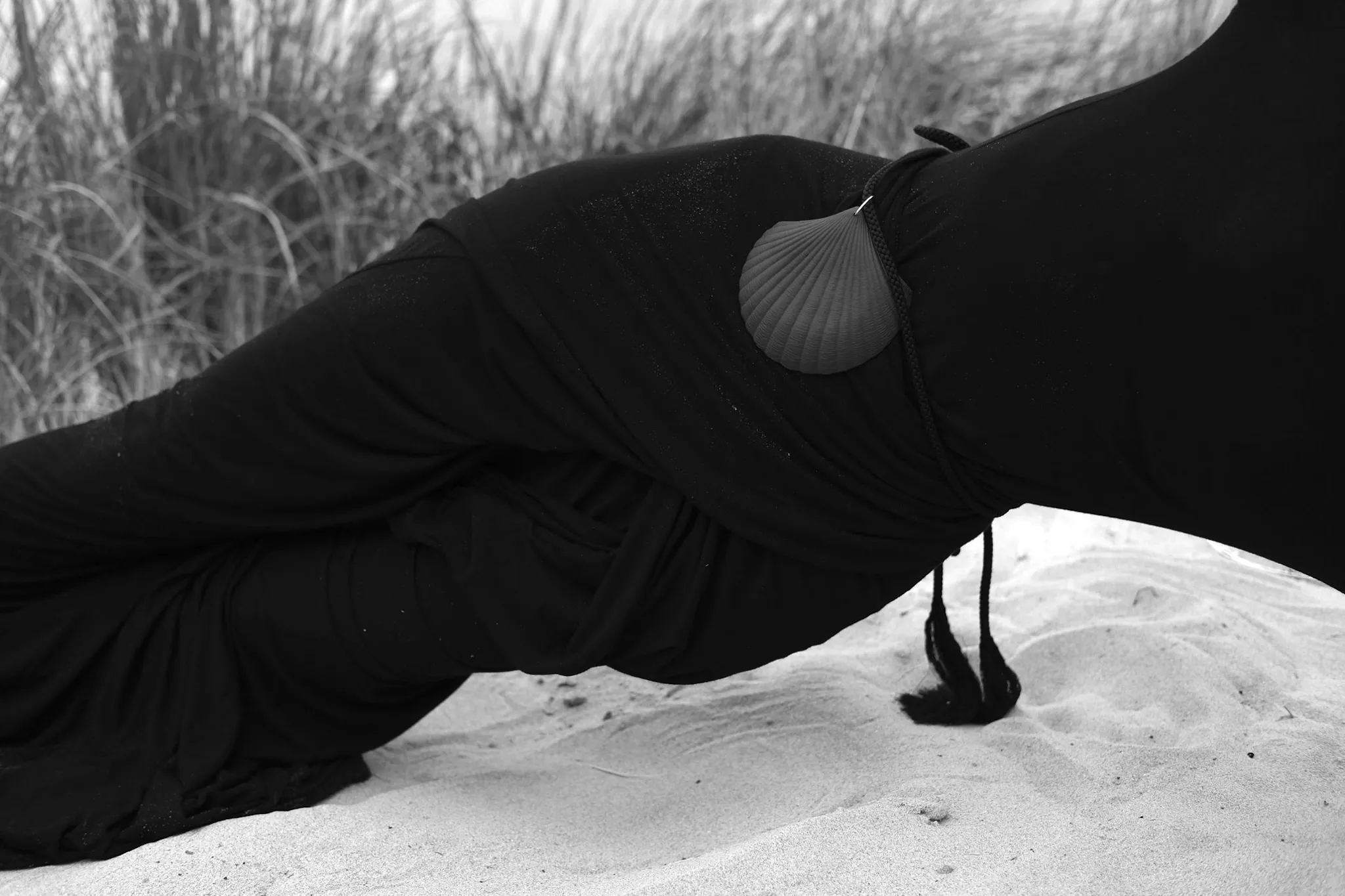
Image in Collaboration with Nikè van de Waal
KWV How are the cultures you yourself have become a part of reflected in Manà?
ET There are three different cultures, three different phases of my life; three different systems of meaning: language, rituals, art, values, shared behaviours. They challenged me deeply but changed me in beautiful ways. I think culture influences me more through emotional memory than through direct visual references. Turkey gave me storytelling, symbolism, rituals and a relationship to objects as carriers of meaning. London taught me research and the freedom to express. And the Netherlands gave me space to search for my authentic self.
KVW I also see some references to Japan.
ET In Japan, nothing is straightforward; there are underlying messages and intentions behind everything. A poetic way to eat, be and live. That’s how I like to live as well. The last time I was there, I was at a temple and noticed this little rock by the front gates and doors with black string wrapped around it — a simple way of telling people not to enter. But that is so beautiful to me, those details. I think I want to live there someday. Or at least go on a pilgrimage and discover another chapter of life.
KVW Another chapter?
ET If you had told me years ago that I would move to this Dutch town called Utrecht, I would have laughed. But life has a funny way of taking you to the most unexpected places, and it becomes more interesting when you surrender to it. Even though it is a challenge sometimes, I don't mind living in that in-between space and trusting what's coming. It almost becomes a superpower — if only you let it.
KVW Wie fliessen die Kulturen, die dich geprägt haben, in Manà ein?
ET Es sind drei verschiedene Kulturen, drei verschiedene Phasen meines Lebens, drei verschiedene Bedeutungssysteme, die hier einfliessen, verschiedene Sprachen, Rituale, Kunst, Werte, gemeinsame Verhaltensweisen. Sie alle haben mich herausgefordert, mich aber auf wunderschöne Weise verändert – mehr aber durch emotionale Erinnerung als durch direkte visuelle Referenzen. Die Türkei hat mich Storytelling gelehrt, Symbolik, Rituale und eine Beziehung zu Objekten als Bedeutungsträger. London hat mir Recherche beigebracht und die Freiheit des Ausdrucks. Die Niederlande haben mir den Raum gegeben, mein authentisches Ich zu suchen.
KVW Ich sehe auch Anklänge an Japan.
ET In Japan ist nichts geradlinig, hinter allem stecken tiefere Botschaften und Absichten – eine poetische Art zu essen, zu sein und zu leben. Als ich das letzte Mal dort war, stand ich in einem Tempel und bemerkte diesen kleinen Stein neben dem Eingangstor, umwickelt mit einem Stück schwarzer Schnur. Es ist schlicht eine Art zu sagen: Zutritt verboten. Aber genau das bewegt mich – diese Liebe zu Details. Ich glaube, ich möchte irgendwann in Japan leben. Oder zumindest auf Pilgerfahrt gehen und ein neues Kapitel aufschlagen.
KVW Ein neues Kapitel?
ET Hätte mir jemand vor ein paar Jahren gesagt, dass ich in diese niederländische Stadt namens Utrecht ziehen würde, hätte ich gelacht. Aber das Leben hat eine seltsame Art, einen an die unerwartetsten Orte zu führen – und wird interessanter, wenn man sich ihm ergibt. Auch wenn es manchmal eine Herausforderung ist: Ich lebe gerne in diesem Dazwischen und lasse offen, was noch kommt.